24 HOUR FIRE & WATER RESPONSE - 7 DAYS A WEEK


The One Mold Problem With a Distribution System
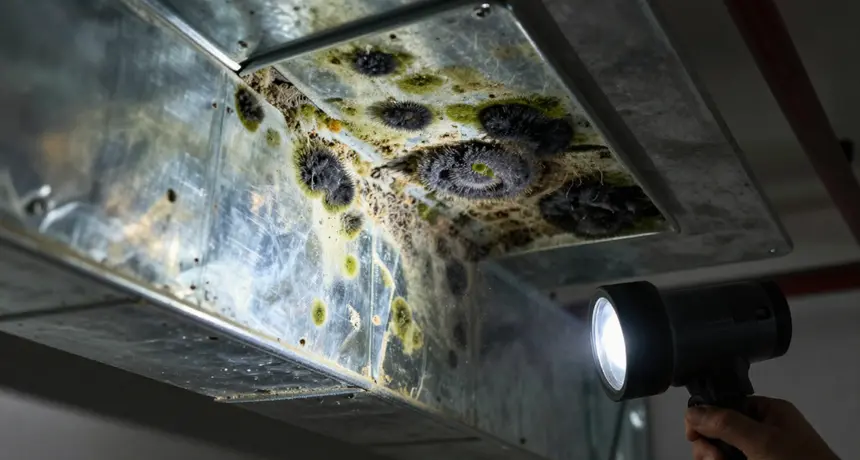
Every other colony in a house is a local problem; the HVAC colony is a broadcast. The system's interior offers mold everything it wants, condensation on the evaporator coil, a drain pan that stands wet, duct interiors that collect the organic dust growth feeds on, fiberglass duct liner that holds moisture like a sponge, and then the blower distributes the output through every register in the house. The tell is the pattern: a musty smell that arrives when the air conditioning cycles on, strongest at the registers, house-wide rather than in one room, often paired with allergy symptoms that track system use. Virginia's humid cooling season makes the coil-and-pan zone a near-permanent wet environment, which is why HVAC growth is a summer-discovery classic in Fairfax.
System assessments book through (703) 397-8315 and cycle-linked odor complaints get walked through diagnostically when you call (703) 397-8315.
Remediating a Machine, Not a Room
The work follows the air path. The air handler opens for coil cleaning, blower wheel degreasing and treatment, drain pan restoration and slope correction so water actually leaves, and insulation-lined cabinet surfaces evaluated honestly, since colonized internal liner is a replacement item, not a scrub. Ductwork gets inspected by camera and cleaned by negative-air machine with agitation, the method that actually removes load rather than redistributing it; colonized flexible duct and internal fiberglass liner come out and get replaced, because porous duct materials cannot be reliably cleaned. Registers, returns, and the filter rack close the loop, and the system restarts on a fresh filter spec matched to the household. Containment and HEPA discipline run throughout per Mold Remediation.
Condensate Is the Root Cause Nine Times in Ten
HVAC mold is a moisture verdict on the cooling system: an oversized unit that short-cycles without dehumidifying, a fouled coil that ices and floods, a pan drain that clogged years ago, a condensate line dumping somewhere it should not, sometimes into a ceiling bay, the loss covered at Ceiling Water Damage. The remediation closes with the condensate corrections and, where the system serves a chronically humid house, the sizing and dehumidification conversation with your HVAC contractor. Attic-mounted systems tie into the attic's own moisture story at Attic Mold Removal, and whole-house humidity patterns into Basement Mold Removal.
 COMMON QUESTIONS
Frequently Asked Questions
More questions? Call (703) 397-8315, answered around the clock.
24/7 EMERGENCY DISPATCH
Registers Breathing Musty Air in Fairfax?
The system is distributing the problem. Call (703) 397-8315 for remediation that treats the machine, not just the ducts. Licensed & insured Virginia contractors · (703) 397-8315 · Fairfax City and Fairfax County