24 HOUR FIRE & WATER RESPONSE - 7 DAYS A WEEK


Is That Ceiling Water Stain Serious? How to Tell
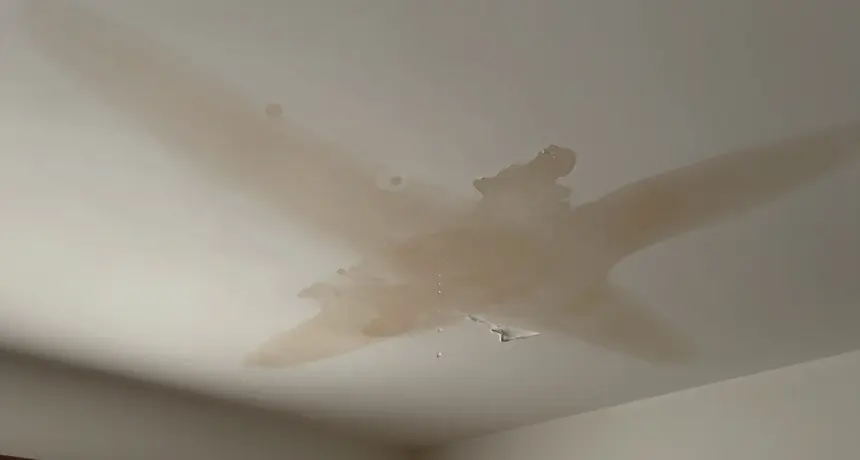
The brown ring on the ceiling is one of homeownership's little Rorschach tests: some people see a painting project, some see a five-figure problem, and the stain itself will not tell you which without a little interrogation. Here is how to read it, and where the honest line sits between watch-it and call-someone.
First question: is it active or historical?
Press the back of your hand to it. Damp, soft, or cool-to-the-touch means active moisture; dry and hard means the water event may be past. Watch it across weather: a stain that grows, darkens after rain, or develops a companion is live, one that holds its outline through a wet week is probably a scar. Rings within rings mean repeated wetting and drying cycles, which is its own answer, whatever feeds it comes back. And any sag, bubble, or belly is not a stain question anymore; that is water weight, the room below gets cleared, and the pond gets relieved before it picks its own moment.
Reading location like a plumber
Under a bathroom: tub and shower surrounds, toilet seals, and supply connections are the suspect list, and a stain that darkens after showers but not baths, or the reverse, is telling you which. Under the roof, especially at exterior walls and around chimneys: flashing, shingles, or, in winter, the ice-dam pattern where melt-water backs under the roofing. Below an upstairs laundry: hoses and drains. And the misdirection rule applies everywhere: water travels framing before it exits, so the stain can sit several feet, occasionally a room, from the true entry, which is why repairing whatever fixture sits closest to the mark sometimes solves nothing.
| What you see | What it usually means | Response |
|---|---|---|
| Brown ring, darker edge, dry to touch | Past event; minerals marked the border | Meter it once, then watch |
| Ring growing or darkening after rain/showers | Live source on a weather or usage schedule | Find the source this week |
| Rings within rings | Repeated wet-dry cycles; it comes back | Source hunt, not paint |
| Gray or black tint joining the stain | Biological growth has started | Containment-minded opening |
| Sag, bubble, or belly | Water weight overhead right now | Clear the room; relieve it today |
The paint-over trap
Stain-blocking primer is a fine final step and a terrible first one. Paint over a bay that is still wet and you get weeks of clean ceiling while the cavity molds in private, insulation composting above the bedroom, drywall paper feeding colonization from the back side. The honest sequence is a meter reading through the stain first, twenty minutes of instrument time that sorts prime-and-forget from open-and-dry, the diagnostic covered at Moisture Mapping. Readings elevated, source live, or history unknown: the cavity work runs through Ceiling Water Damage.
The stain vocabulary: color and shape carry information
Brown rings with darker edges are the classic slow-leak signature, minerals and tannins carried to the stain's border as each wetting dries. Yellowish, spreading patches suggest ongoing low-level moisture. Gray or black arrivals mean biological growth has joined the party, which changes the response from drying to containment-minded. Straight-line stains that follow a joist bay point at water traveling framing from a distance; a crisp circle under a bathroom points nearly straight up. None of this replaces a meter, but it tells you how fast to reach for the phone.
What the cavity looks like behind a live stain
The part paint hides: a stain's cavity holds wet insulation pressed against the drywall's back, framing that has been damp for however long the leak has run, and, past the first days, colonization on the paper facing where you cannot see it. A proper fix opens the bay at the stain, dispositions the insulation, dries the framing to reference readings, and only then closes and primes. It is a one-to-two-day scope on most single-bay stains, which is roughly what people spend repainting the same stain twice.
When it is genuinely urgent
Escalate past watch-it when the stain sags or grows visibly, when it sits near a light fixture or fan, water and energized fixtures get the breaker turned off, not a wait-and-see, when a musty smell joins it, or when the ceiling below is plaster in one of the area's older homes, where saturated plaster fails heavy and fast. Condo dwellers along corridors like Falls Church 22042 add one more trigger: a stain in a stacked unit means someone else's plumbing on a schedule you do not control, and the assessment protects you regardless of whose fault the water turns out to be.
 24/7 EMERGENCY DISPATCH
Ceiling Stain You Cannot Read?
Twenty minutes with a meter answers it. Call (703) 397-8315 before the primer goes on. Licensed & insured Virginia contractors · (703) 397-8315 · Fairfax City and Fairfax County